Night U-boat attack on the convoy and Keeling’s counterattack
The Good ShepherdNight U-boat attack on the convoy and Keeling’s counterattack is a night engagement in which Keeling tries to stop a surfaced submarine from reaching the merchant ships. Krause’s intervention turns the destroyer from a distant escort into a ship threading the convoy’s lanes under fire. The action produces no confirmed account of the U-boat’s fate: Keeling attacks it, but the immediate evidence is a burning ship, a rescue operation, and a submarine that may still be at large. The episode makes tactical success inseparable from the risks of protecting the convoy and the finite resources needed to keep doing so.
A screen under strain
The encounter takes place within an escort force already stretched across a large convoy. Earlier, a contact had drawn James away from the main screen, with Viktor assisting her. Krause had to weigh the possibility of destroying a U-boat against the danger of leaving gaps through which other submarines could approach. Detaching ships at high speed would also consume fuel needed to rejoin a convoy likely to be moving away. He therefore treated the escort’s small reserve as a battle resource, not a surplus to be spent automatically on every uncertain contact.
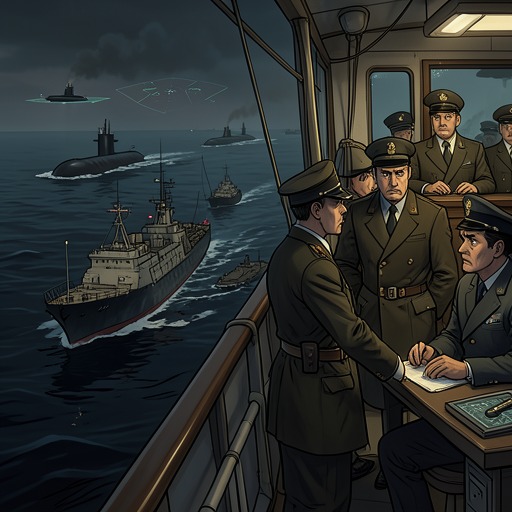
Keeling remained in Condition Two, a heightened readiness that kept many battle duties staffed and the ship’s watertight integrity maintained. Krause declined to call general quarters merely because James and Viktor were pursuing a contact: a full alarm would stop routine work, cost the crew rest and meals, and could not be sustained for long. Repeated alarms without a clear need also risked making men slack when an actual emergency came. The distinction between Condition Two and full battle stations was therefore operational, not ceremonial; readiness had to be preserved without exhausting the people expected to act.
That calculation was reinforced by the ship’s staffing limits. Keeling had new weapons and instruments, but too few trained ratings to provide three complete watches in Condition Two, and little room to accommodate or feed additional personnel. Krause had divided the crew into four sections on a watch-and-watch routine, while most officers worked four hours on and eight off. Even after contact with the enemy had continued through the day, he chose not to interrupt the watch below with a routine general-quarters call. The choice preserved rest for a crew already living under sustained strain, while leaving the ship prepared to respond if the situation became urgent.
The convoy itself required continuous attention. Seven lookouts scanned separate sectors, pausing to clear spray from their binocular lenses. A submarine might show only a small part of its periscope and remain visible for less than half a minute, so a momentary lapse could matter. At the same time, Krause had to watch the convoy’s station-keeping and smoke, and remain close enough to the TBS radio-telephone to direct the escort. The action unfolds within this system of distributed observation: reports from lookouts, gunnery control, and the ships in contact must be turned into decisions before the threat reaches the merchant vessels.
Interception across the convoy
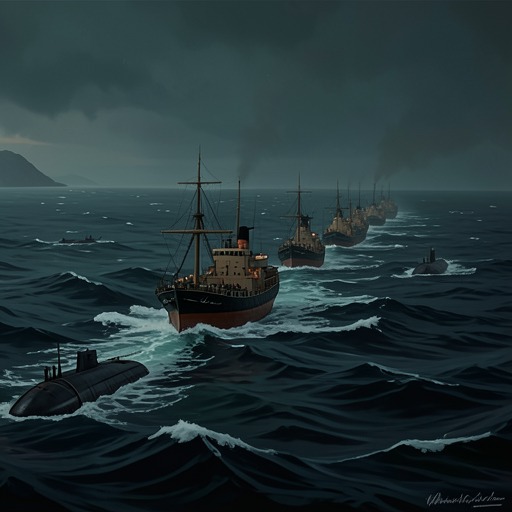
The immediate alarm comes as Krause is briefly away from the bridge. A report of gunfire on the port bow brings him to the TBS radio-telephone, where James and Viktor are communicating with increasing urgency. A star-shell rises, revealing a surfaced U-boat between the escort screen and the convoy. Its position and course make the threat plain: it is driving toward the merchant ships rather than withdrawing from them.
Krause orders Keeling across the convoy’s bows and warns the other destroyer to watch for her. The ship must cross close ahead of the advancing columns, and the first report places the submarine broad on the starboard bow at a range of 3,500 yards. A later bearing and range, 042 degrees and 3,200 yards, indicate that the U-boat is crossing Keeling’s bow toward the convoy. Krause delays firing until the submarine is close enough for the destroyer’s presence to remain a surprise. Once a second star-shell illuminates the sea, the U-boat’s grey shape appears less than two miles ahead, moving at speed.
Keeling opens fire with her five-inch guns and 40 mm guns. The target changes course, and the guns temporarily lose it in the confusion of the engagement. Then a report of a ship directly ahead forces Krause to order a hard turn. Keeling passes close beside a merchant ship and enters the lane between the convoy’s columns. The maneuver avoids a collision, but it also places the destroyer among the ships she is trying to protect, with little room to make a mistake.
The submarine reaches the next lane and attacks there. A rocket and machine-gun fire are followed by a large burst of flame from a merchant ship and an explosion. Keeling is also fired upon: a ship in the convoy mistakes the destroyer for the U-boat and sweeps the front of the pilothouse with machine-gun fire, shattering its glass. The first bullets to endanger Krause in battle come from a friendly ship, an abrupt consequence of darkness and confusion rather than an attack by the enemy. Krause asks whether anyone is hurt but does not pause to wait for an answer; the immediate task is to regain the threat.
Counterattack and uncertain result
A U-boat superstructure appears beyond the burning ship, but a wave hides it before Keeling can be certain of its position. Krause orders a medium depth-charge pattern and starts an ASDIC sonar search. The calculation is compressed into minutes: the submarine’s estimated distance, its likely movement, Keeling’s speed, and the noise of the convoy’s many propellers all affect where the charges must fall. The K-guns fire, and explosions spread through the water behind Keeling. Krause orders a further pattern as the ship turns back toward the burning vessel.
The burning ship grows larger as Keeling approaches. A tremendous explosion is followed by darkness and a temporary loss of sight and hearing in the pilothouse. When the crew’s senses return, the ship is moving through foam-flecked water. Cadena is reported a mile ahead, already engaged in rescue work. Another report finds three convoy ships well astern. Given that both a destroyer and a U-boat have crossed through the formation and a merchant ship has been struck, the limited number of ships out of station is notable; nevertheless, the attack has disrupted the convoy and left survivors in the water.
A cry from the sea draws attention to a dark object close on Keeling’s port bow. At least one survivor appears to be on wreckage or a life-raft, but the person faces exposure in the cold water. Cadena is about a mile away, and Krause considers whether to bring the rescue ship back. He does not treat that as a simple humanitarian detour: approaching and signaling Cadena would take time, while the U-boat may still be within torpedo range. The scene places the immediate need to help a survivor against the continuing danger to the rescue vessel and the convoy.
The submarine’s final status is not established by the encounter. Keeling has attacked with guns and depth charges, but no sinking is confirmed in the available account; the reports instead leave the enemy’s location and survival uncertain. That uncertainty matters because an unsuccessful attack may still consume the means needed for another one. Across the preceding twenty-four hours, Keeling has expended more than seven tons of explosive. The latest pattern brings the number of charges used in it to thirty-eight, leaving only six aboard, including extra charges brought up from the crew’s living quarters.
The cost of continued action
With only six depth charges remaining, Krause has to stop firing full patterns. The decision is shaped by the mathematics of the search as well as the depleted stock: halving a pattern reduces the searched area’s chance of a hit to a quarter, while reducing it to a third leaves only a ninth of the former chance. Yet even one charge exploding within hearing distance could deter a U-boat or force it to evade. Ammunition therefore has both a direct destructive use and a limited delaying effect, but neither makes the supply renewable.
Krause also considers the likely conditions ahead. By the following morning the convoy should be within the radius of air cover, and moderating weather may make that protection more useful. Intelligence he has studied indicates that U-boats have recently been less willing to attack convoys in the eastern Atlantic. These expectations do not resolve what happened to the submarine during the night; they inform how much further effort Keeling can justify after its ammunition has nearly run out.
The action’s decisive tension is thus larger than the exchange of gunfire. Krause must preserve an escort screen, crew endurance, fuel, and weapons while responding to a submarine whose position is only intermittently visible. Keeling’s close passage through the convoy prevents an immediate collision and brings the destroyer into the fight, but it cannot remove the risks created by darkness, mistaken identification, or incomplete information. The burning ship and Cadena’s rescue work mark the human consequence of the attack; the six remaining charges mark the operational limit of the counterattack.